Beyond Openness:
A new paradigm for understanding adoption—Part 1
By Richard Pearlman, LCSW
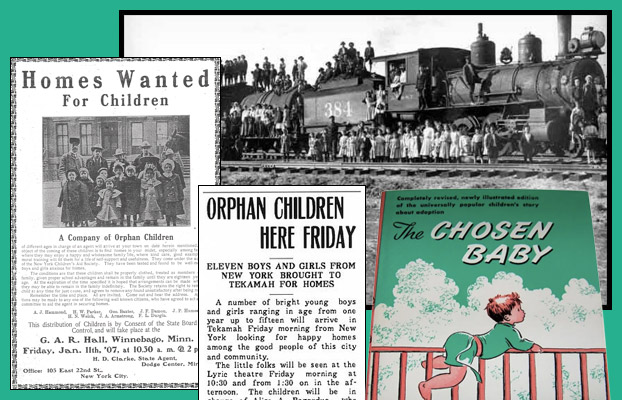
For decades the adoption field has moved from one prevailing model to another — from orphan trains, to closed adoption, to the modern concept of open adoption. But each paradigm has revealed its own limitations. Understanding adoption may require a different way of thinking about family altogether.
How adoption paradigms take hold
The field of adoption has been in a constant state of change since the early 1850s and the advent of orphan trains. From one generation to the next, societal attitudes have shifted as prevailing paradigms changed. A paradigm is a model or pattern for something that may be copied, or a theory or group of ideas about how something should be done or thought about.
Robert Noone, Ph.D., wrote in the Spring 2016 Family Journal, “New paradigms generally emerge when a sufficient number of discrepancies or anomalies arise which cannot be explained within the predominant paradigm.”
The orphan train experiment
From the vantage point of today it is easy to see the discrepancies that arose during the epoch of the orphan trains. At that time taking children from the streets of Eastern slums and putting them on trains headed west for the purpose of placing them for adoption was an accepted practice. Children were placed with strangers with scant background checks or child protection measures. The term “putting up for adoption” stems from this era. Although today these practices would be seen as barbaric, the existing adoption paradigm during that era led society to view orphan trains as an accepted way to provide stable families for children facing parental death, neglect or abandonment.
Orphan trains ran from 1854 until 1929 and as many as 250,000 children from Eastern cities were sent to towns in the West, Midwest, Canada and Mexico. The Orphan Train movement paid little regard to the best interests of children, or the rights of their genetic/biological parents and relatives. When orphan trains arrived at a train station, interested townsfolk showed up to look at and choose children who were put up on boxes and displayed on station platforms. Though the “placing agency” maintained the right to remove a child from a home if the child was mistreated, this rarely happened and placements were made with virtually no investigations or follow-up oversight.
Looking back at past assumptions
How was it that the best and the brightest at that time saw nothing wrong with this practice? Is it possible that there is an equivalent situation today, and perhaps, in the future we will look back and wonder how we failed to see the problems inherent in the way adoption is practiced today?
Notice what is being said at the time of the orphan train phenomenon. In the “agreement” between adoptive parents and Children’s Aid Society of New York: “Children are not allowed to correspond with any friends or relatives without obtaining permission to do so from the Society.” — Children’s Aid Society, New York
The orphan train movement marked the beginning of the philosophy that adopted children should not have contact with the kinship network from which they came, even though many were older and had clear memories of parents, aunts, uncles, cousins and grandparents who were left behind.
The orphan train movement paradigm discouraged and obstructed contact with families of origin and it continues to influence the practice of adoption today.
Early thinking about contact with families of origin
One of the most important seminal events that took place in the modern adoption era occurred in 1939 with the publication of Valentine P. Wasson’s book The Chosen Baby. This book established a new paradigm and set a tone for adoption that continues to reverberate today. It provided a framework for social workers, adoption professionals and adoptive parents to explain adoption to children who were adopted and to society as a whole.
Let’s look at several passages from the book:
Once upon a time in a large city lived a Man and his Wife. They were happily married for many years. Their one trouble was that they had no babies of their own.
One day they said to each other: “Let us adopt a baby and bring him up as our own.” So the next day they called up a Home which helps people to adopt babies, and babies to adopt parents, and said: “We wish so much to find a baby who would like to have a mother and father and who could be our own. Will you help us find one?”
(Jumping ahead to later in the same page)
Many months went by and the Man and his Wife would say to each other: “I wonder when our baby will be coming.” And the Wife would call up the Lady at the Home and say: “We are still waiting for our baby. Please don’t forget about us.” And she would be told not to worry, for the baby was sure to come some day.
Then suddenly one day the Lady at the Home called up and said: “We have three fine babies for you to choose from. Will you both come and see them?” So the very next day the Man and his Wife, feeling very excited, hurried to the Home. The Lady told them all about the babies.
— The Chosen Child, Valentine P. Wasson, 1939
The idea of choosing the “right” child
Throughout the years the book went through several revisions, and later versions gave the husband, wife and adoption worker names. However, even as the book was modernized, the original message did not change.
In a later revised edition Wasson writes:
“We have a baby boy for you to see. Can you come to my office tomorrow?”
The very next morning, the Browns hurried to Mrs. White’s office. First Mrs. White told them all about the baby boy they were going to see. Then she said, “Now go into the next room and see the baby. If you find that he is not just the right baby for you, tell me and I will try and find you another.”
Notice that in the beginning the Man and Wife got to examine three babies and in a later edition they were only presented with one baby. However, they had the right to decide if the baby was “just right” for them.
Look at what the paradigm established by The Chosen Child does and does not do. Adoptive parents would get to “choose” the perfect child. The book firmly established the “right” of adoptive parents to obtain a baby that was “right” for them. It set forth the idea that if the child being placed for adoption was not “just right,” the agency would endeavor to find the adoptive parents another one. It set a precedent for “agencies” being the arbiters of adoption and the notion that birth parents and families of origin had no part in the adoption process. Babies appeared out of thin air and there was no thought given to where they came from or the people they were related to: aunts, grandparents, brothers and sisters, cousins, or original mothers or fathers.
Major shifts in adoption practice
Subsequent to the publication of Wasson’s book there was a cascade of changes in the field that influenced the practice and understanding of adoption. The limitations placed on the size of this article compel me to jump ahead and to just touch on other developments in the field that influenced the prevailing paradigms.
There were cases that led to establishing the importance of safeguarding children, making a child’s well-being a central component of adoption. Transracial adoptions began to take place, and laws prohibiting black market adoptions were passed in some states, although even today, enforcement of these laws has proved to be difficult. There was the rise in international adoptions.
By 1970, adoptions reached their statistical peak at approximately 175,000 per year, with almost 80 percent being arranged by licensed agencies. In 1971 organized groups were established “…to abolish the existing practice of sealed records” and to advocate for “opening of records to any adopted person over 18 who wants, for any reason, to see them.”
The efficacy of placing children of color (African American and others) with Caucasian parents was fought in the courts and the arena of public opinion, finally in 1994 resulting in the U.S. senate passing the Multiethnic Placement Act (MEPA), mandating that race could not play a role in determining the homes in which children were placed for adoption.
In 1996 a group calling itself Bastard Nation was founded with a mission to promote “the full human and civil rights of adult adoptees,” including access to sealed records.
From closed adoption to open adoption
Throughout the years, societal attitudes and assumptions toward adoption changed, and widely accepted ideas of “best practices” gave way to whole new beliefs.
When I began working in the field in 1982 the widely held view among adoption professionals was that closed adoption was best for “everyone.” When the agency I founded in 1988 proposed that it was possible for birth parents and adoptive parents to work together to create responsible adoption plans, we faced antagonism and hostility from older, more established agencies.
Many were mortified that we were providing opportunities for birth parents and adoptive parents to communicate directly. We were told it would never work and accused of not respecting well-established practices. We were criticized for disrupting a system that was working just fine.
Nonetheless, starting slowly in the early 1980s leading up to now, most agencies shifted from fierce advocacy for closed adoption to equally fierce advocacy for open adoption. A new adoption paradigm, supporting open adoption was being established.
Why open adoption still leaves people confused
The problem then and now with the open adoption paradigm is that there is no unanimity of thought about what it means. If 50 agencies or 50 individuals were asked to describe open adoption you would hear 50 different descriptions.
In Part II of this article the existing paradigm of open adoption will be challenged and a new adoption paradigm will be proposed and defined.
Richard Pearlman is a retired licensed clinical social worker and former founder and executive director of the Adoption Center of Illinois at Family Resource Center. He helped draft the 2005 Illinois Adoption Reform Act, which ended the commercial practice of adoption in Illinois and championed birthparents’ rights. In 2025, he founded the Adoption Chronicles Project which showcases adoption experiences from all points of view. He lives in Chicago and continues to write and speak about adoption and family systems.